



Morphological ageing · Observational framework
Fundamentals
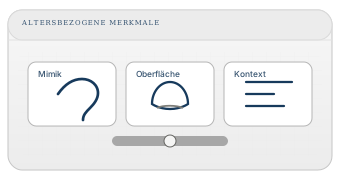
With increasing age, skin relief, wrinkle and furrow patterns, soft-tissue contours and individual facial regions change. Such changes matter when image material from different life phases is compared or when individual features shift in evidential value.
What matters here is the distinction between observable change and change that is professionally sustainable in an expert context. Not every visible wrinkle, contour shift, or soft-tissue change is recognisable in the available material in a way that permits a clean conclusion. For practical classification, the main issues are therefore wrinkle and furrow patterns, soft-tissue changes, contour shifts, and the question whether these can be assessed with sufficient methodological support on both sides of the image comparison at all.
Facial ageing is not limited to individual lines or furrows. It changes the overall visual impression and can affect recognition as well as the comparison of faces. In image comparison, it is therefore necessary to distinguish age-related variation from morphological properties that remain comparable despite the passage of time.
Morphological ageing · Comparative relevance
Relevance for image comparison
Across larger time intervals, considering morphological ageing prevents age-related changes from being treated as identity features. It helps to separate changes that are usual for age from findings that actually carry weight for the identity question. Precisely for that reason it is important in practice: it does not reduce evidential value, but stabilises it by limiting premature conclusions.
This field becomes important where older reference images, widely separated recording dates or pronounced changes in the soft-tissue profile have to be assessed.
For practice, morphological ageing protects against over-interpretation. It separates age-typical changes from findings with weight for the identity question and prevents premature conclusions from apparently striking changes. With larger time intervals between questioned and comparison image, this step separates age-typical, technical and identity-related deviations.
Morphological ageing · Professional context
Relation to age estimation
In the context of age estimation, attention to visible facial changes may be useful as a supplement. It does not, however, replace an independent age estimation. The specialist literature points out expressly that in adulthood visible age estimations are possible only very roughly and rely more strongly on typical age changes such as wrinkle formation, soft-tissue changes, and contour shifts. Visible facial features can therefore be used only as a supplement; the main expert conclusion must rest on a methodologically more sustainable framework of findings.
Morphological ageing · Limits of inference
Limits
Age-related change is strongly influenced by image quality, lighting, facial expression, body weight, health status, and the time interval between the recordings. Precisely for that reason a cautious classification is mandatory. What in everyday life appears to be a clear age difference is, in expert terms, often usable only to a limited degree. This very limit shows that morphological ageing remains an important, but methodologically limited component within a larger overall assessment.
Morphological ageing · Further orientation